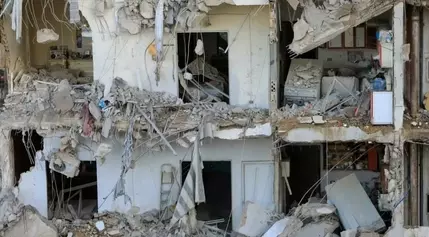
Israel's Relentless Strikes: Crippling Hezbollah's Financial Lifeline
In a bold move to disrupt Hezbollah's operations, the Israeli military has expanded its air strikes beyond traditional military targets, hitting a Lebanese association linked to the group. The strikes, which targeted branches of the Al-Qard al-Hassan financial institution, aim to degrade Hezbollah's ability to fund its activities, including the purchase of weapons and payments to its fighters.Cutting Off the Lifeblood: Israel's Assault on Hezbollah's Finances
Targeting the Financial Backbone of Hezbollah
The Israeli military has launched a series of strikes against "dozens of facilities and sites" used by Hezbollah in Beirut and southern Lebanon, including branches of the Al-Qard al-Hassan financial institution. This strategic move is part of Israel's efforts to undermine Hezbollah's financial capabilities, which the Israeli government accuses of funding the group's "terror activities."Al-Qard al-Hassan, a Hezbollah-linked financial firm, has been providing microcredit services in a country where the traditional banking system has collapsed due to a crushing economic crisis. By targeting these branches, Israel aims to disrupt the flow of funds that sustain Hezbollah's operations, including the acquisition of weapons and the payment of its fighters.Expanding the Scope of the Conflict
The latest strikes mark an expansion of Israel's nearly monthlong war with Hezbollah. The attacks have extended beyond traditional military targets, with the Israeli military now focusing on the group's financial infrastructure. This strategic shift underscores the importance Israel places on crippling Hezbollah's ability to fund its activities.The strikes have hit Al-Qard al-Hassan branches in various parts of Lebanon, including the cities of Nabatieh and Tyre in the south, as well as the Bekaa Valley in the east. The attacks have also targeted a location near Beirut's airport, a critical entry point for humanitarian assistance and a major evacuation hub for those fleeing the conflict.Disrupting Hezbollah's Funding Channels
By targeting the financial institutions linked to Hezbollah, Israel aims to disrupt the group's ability to fund its operations, including the purchase of weapons and the payment of its fighters. This approach represents a significant escalation in the ongoing conflict, as the Israeli military seeks to undermine Hezbollah's financial foundations.The strikes on Al-Qard al-Hassan are part of a broader strategy to degrade Hezbollah's capabilities and limit its influence in the region. By targeting the group's financial lifeline, Israel hopes to weaken its overall operational capacity and make it more difficult for Hezbollah to sustain its activities.Heightening the Humanitarian Concerns
The strikes near Beirut's airport, a critical hub for humanitarian assistance and evacuation efforts, have raised concerns about the potential impact on the civilian population. As the conflict intensifies, the humanitarian situation in Lebanon is likely to become increasingly dire, with the disruption of aid and the displacement of people adding to the already challenging circumstances.The Israeli government has justified the strikes as a necessary measure to counter Hezbollah's "terror activities," but the collateral damage and the potential for further escalation have raised concerns among the international community. The delicate balance between military objectives and humanitarian considerations will be a crucial factor in the ongoing conflict.Implications for the Regional Dynamics
The Israeli strikes on Hezbollah's financial infrastructure have the potential to reverberate throughout the region. The conflict between Israel and Hezbollah is deeply intertwined with the broader geopolitical dynamics in the Middle East, with Iran's support for the Lebanese group being a significant factor.The escalation of the conflict and the targeting of Hezbollah's financial networks could have far-reaching implications, potentially drawing in other regional actors and further destabilizing the already volatile situation. The international community will be closely monitoring the developments, as the outcome of this conflict could have significant implications for the regional balance of power and the broader security landscape.New








35.5K
2.1K
234
Cars

4.8K
47
20
Cars






42.5K
2.1K
233
Finance


36.5K
2.9K
1.5K
Health